
Automation: history, development, and automated systems

Automation: history, development, and automated systems
Automation represents the historical evolution of delegating repetitive labor to self-regulating mechanisms. For modern digital implementation principles, see our comprehensive guide on business process automation fundamentals.
An " automated operation " is inaccurately called self-operation, as the first term is a more precise expression of the so-called English Machining.
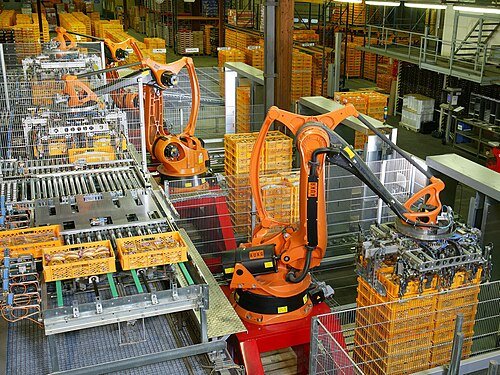 Autonomous Industrial Robots Operating in a Modern Manufacturing Facility
Self-functioning 12 or 7 or automated works 1 is also intended to make everything self-employed without human interference, so the automated industry can be called an industrial automated.
The words mechanization or mechanization (English: Mechanization ) are sometimes used to talk about automation as well, and mechanization is linguistically derived. From the Latin word “machine/machine”, which means in Arabic: machine. Semantically, it means: introducing machines into work and transforming it from manual to automated work. It is equivalent to mechanization in Arabic: ta'leel. However, automation or autonomous operation differs from mechanization in that autonomous operation is related to the use of electronics to perform tasks, while the term mechanization is associated with the use of machines to save human effort and time.
The automated machine consists of three parts:
Machine (or machine)
Superintendent (computer),
A programme written in a particular software language so that the computer understands it and translates it into work on the piece, such as excavations, deafness, dismemberment, etc.
Description of automation
Automation is the use of computers, process-based devices, controls and software in various industrial, commercial and service sectors to ensure that procedures and actions are conducted in an automated and proper manner and at least as wrong as possible.
Recently, using micro-processing (PLC), software has played a significant role in the rapid development of automation engineering and, to this point, automation continues to be unwavering by using all new techniques and informatics to improve its performance and develop its potential.
The term " N.C. ": digital control and digital control of Computer Numerical Control11 is a type of software automated for the machine, where the controller Controller sends Instructions to the part where the work is done (the machine) works, works Parts) for manufacturing operations, and consists of the main parts we have previously mentioned, where the computerized data contains the logo.
Industrial and educational requirements
Existing control systems require a high level of engineering potential to meet the requirements of modern techniques and economic pressures. Industrial control includes a spectrum of services from initial design to integrated engineering application. Specialization areas include automation, control and software solutions, including: automated studies and engineering exercises in automated areas, in particular the design of a softwareable logic control device (programmable logic control software and software)
Advantages and disadvantages of automation
At the very beginning: increased production. ∙ Increased accuracy. ∙ Improvement of resilience. Poor: security threats. It is true that automation is an effective but limited system of intelligence.
Computer applications
An important computer application in the computer manufacturing process is application (CAD/CAM), i.e. computer design and manufacturing Computer Aided Design/Computer Aided Manufacturing, where application provides an excellent environment for engineering designs with the possibility of changing the dimensions or any errors that may be found in the design easily, with the possibility of multiple copies of design and the ease of keeping, and the database for the piece, which it is designed to produce, and then send an engineering information on the piece control.
Through Simulation, we can learn a lot of errors and weaknesses in design before it is actually produced from the raw material, and a similar manufacturing process can be carried out on a sample of other substances, such as plastics, to learn more errors and thus redesign the part that causes defects, after the sample is free of defects, then direct production can be made.
Human capital The labs are dead.
- Jump up to: 1 2 3 Mahmoud Ahmed Hamdan (2007). Dar Al-Ilm Comprehensive Engineering Dictionary (in Arabic and English) (ed. 2). Beirut: Dar al-Ilm Lil-Malayin. P.71. ISBN: 978-9953-9026-9-2. OCLC: 1012683023. OL: 13208969M. QID: Q124796283.


