
Relational Database (RDBMS): Modeling, Relationships, and SQL Query System

Relational Database (RDBMS): Modeling, Relationships, and SQL Query System
A relational database (RDB) is a database system structured according to the relational model of data, introduced by British computer scientist Edgar F. Codd in his seminal 1970 paper. A Relational Database Management System (RDBMS) is the software engine that stores, manages, queries, and updates data formatted as structured relations (tables) comprising tuples (rows) and attributes (columns). Most relational database systems implement Structured Query Language (SQL) as the standardized declarative interface for data definition (DDL), data manipulation (DML), and access control (DCL).
History
Edgar F. Codd first defined the relational model at IBM's San Jose Research Laboratory in June 1970 in his landmark publication, "A Relational Model of Data for Large Shared Data Banks". Codd introduced the mathematical concept of representing business entities and relationships through first-order predicate logic and set theory, formalizing twelve strict rules (Codd's Twelve Rules) that define a true relational database system.
While commercial relational database engines vary in their strict adherence to every theoretical rule, practical systems adhere to foundational relational standards:
- Tabular Data Representation: Presenting all data to users and applications strictly as relations—tables consisting of distinct rows and named columns.
- Declarative Data Manipulation Operators: Providing high-level mathematical operators that transform and query tabular data without exposing low-level physical file pointers.
In 1974, IBM launched System R, an influential research project that proved the feasibility of relational architectures and invented Structured English Query Language (SEQUEL), later standardized as SQL. Relational systems quickly commercialized: Multics Relational Data Store was developed in 1976, followed by Relational Software Inc. (later Oracle Corporation) launching the first commercial SQL RDBMS in 1979, and IBM releasing DB2 in 1983.
Early academic implementations of the relational model included:
- Micro DBMS (1969): University of Michigan.
- Peterlee Relational Test Vehicle (PRTV, 1973–1979): IBM UK Scientific Centre.
- Ingres Project (1974): UC Berkeley, which pioneered the QUEL query language and spawned commercial engines including Ingres, Informix, Sybase, and PostgreSQL.
Relational model
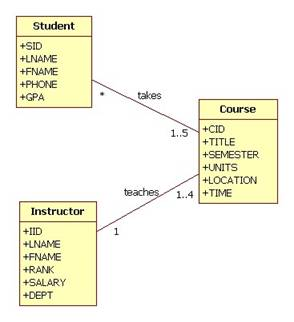 Relational Database Entity-Relationship (ER) Schema: Student, Course, and Instructor Relationships
The relational model organizes data into one or more named tables (relations). Each table possesses a defined schema comprising fixed columns (attributes) with assigned data types and domains. Each horizontal entry represents a unique row (tuple), representing an individual entity instance (e.g., a customer, product, or ledger entry).
For example, in an enterprise student management database, each row in a Classes table represents a distinct course offering. A course can enroll multiple students whose records reside in a Students table, establishing a one-to-many (1:N) relationship managed through relational keys.
Keys
Relational tables rely on keys to uniquely identify tuples and establish referential relationships across entities:
- Primary Key (PK): A column or combination of columns chosen to uniquely identify each row in a table. Primary keys must be unique and cannot contain null values. Database engines generate clustered B-Tree indexes on primary keys to optimize retrieval performance. Organizations often utilize surrogate keys (system-generated auto-increment integers or UUIDs) rather than business natural keys to prevent schema instability.
- Foreign Key (FK): A column in a child table whose values must match the primary key of a parent table. Foreign keys establish logical links between tables, enforcing referential integrity.
- Junction Tables (Composite Keys): When modeling many-to-many (N:M) relationships (e.g., students enrolling in multiple courses), a junction table is created containing foreign keys referencing both entities, which combine to form a composite primary key.
Relations
Relations model the logical associations between enterprise entities. In relational database design, Entity-Relationship (ER) diagrams establish cardinality (one-to-one, one-to-many, and many-to-many) before physical tables and foreign key constraints are generated.
Transactions
To maintain data integrity under concurrent user access and system failures, enterprise RDBMS engines enforce the ACID transactional guarantees:
- Atomicity: All operations within a transaction execute successfully, or the entire transaction is rolled back with zero modifications committed.
- Consistency: Transactions transition the database from one valid state to another, strictly obeying all schema constraints, cascades, and business triggers.
- Isolation: Concurrent transactions execute independently without mutual interference, managed via transaction isolation levels (Read Committed, Repeatable Read, Serializable) and Multi-Version Concurrency Control (MVCC).
- Durability: Once a transaction is committed, its modifications survive unexpected hardware power losses and crashes via Write-Ahead Logging (WAL).
Stored procedures
Stored procedures are precompiled collections of SQL statements and procedural logic stored directly within the database catalog. Stored procedures reduce client-server network roundtrips, encapsulate complex business transactions, and enhance database security by granting application roles execute permissions on procedures while restricting direct table read/write access.
Terminology
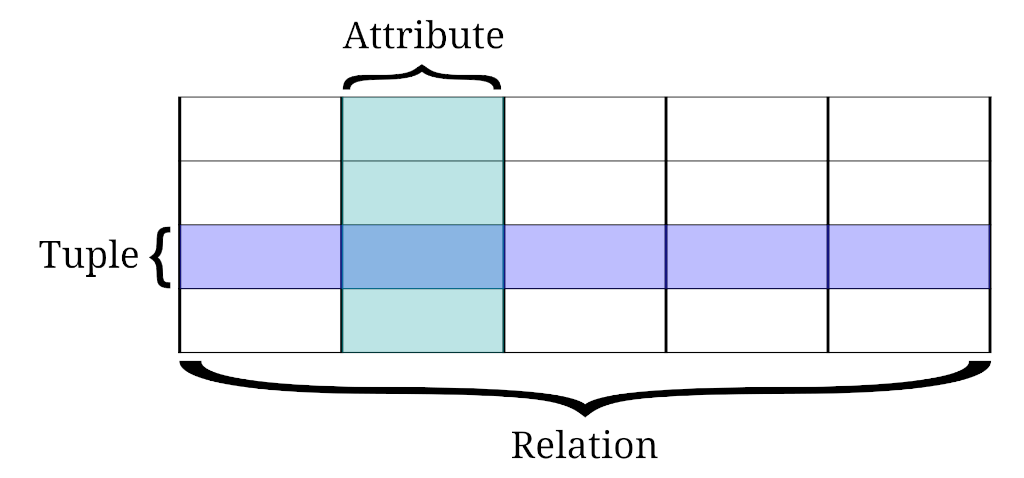 Relational Data Structure: Attribute Columns, Tuple Rows, and Bounded Relation Table
Relational theory uses precise mathematical terminology, which maps directly to familiar SQL database implementations:
| SQL Operational Term | Formal Relational Term | Structural Description | Physical Engine Mapping |
|---|---|---|---|
| Row / Record | Tuple | Discrete instance of entity attributes | Physical data page record |
| Column / Field | Attribute | Named property associated with a data domain | Typed column schema |
| Table | Relation / Relvar | Bounded set of tuples sharing identical schema | Storage heap or clustered index |
| View / Result Set | Derived Relation | Virtual relation evaluated via declarative query | Dynamic execution plan or materialized view |
Relations or tables
In an RDBMS, a table contains an unordered collection of tuples. Schema constraints define valid data types, character encodings, and maximum lengths. Applications query and mutate data declaratively using SQL statements: SELECT queries filter and project tuples, while INSERT, UPDATE, and DELETE statements modify table state within ACID transactions.
Base and derived relations
- Base Relations: Physical tables whose records are written and persisted directly to non-volatile disk or solid-state storage.
- Derived Relations: Virtual views and query result sets dynamically computed by executing relational algebra operators against base relations. Views can encapsulate complex joins, enforce row-level security, and simplify application query syntax.
Scope
In relational theory, scope (or domain) defines the set of permissible values assigned to an attribute. A domain acts as an inherent semantic constraint: an integer column will reject string values, while an enumerated field (Order_Status) restricts valid input to specified state strings (Pending, Approved, Shipped).
Restrictions
Constraint restrictions enforce organizational business rules at the database engine level, preventing corrupt data ingestion before it reaches application layers:
Primary key
Ensures entity uniqueness within a relation. Surrogate keys (integers, bigints, or UUIDv4/v7) provide stable, immutable identifiers that shield internal foreign key relationships from external business changes.
Foreign key
Maintains referential integrity across related tables. Foreign key constraints can be configured with cascading behaviors:
ON DELETE CASCADE: Automatically deletes child records when the referenced parent record is deleted.ON DELETE RESTRICT/NO ACTION: Aborts deletion if dependent child records exist.ON DELETE SET NULL: Retains child rows while setting their foreign key pointers to null.
Stored procedures
Encapsulate multi-step transaction pipelines, batch data reconciliations, and complex analytical aggregations within database engine execution boundaries.
Indexes
Indexes are auxiliary data structures (predominantly balanced B+ Trees or Hash indexes) created on specific table columns to accelerate search and filter queries. While indexes reduce query latency from full table scans (O(N)) to logarithmic lookups (O(log N)), they introduce write overhead during row insertions, updates, and deletions.
Relational operations
Edgar Codd defined eight core relational algebra operators, divided into foundational set theory operations and specialized relational operators:
- Union (∪): Merges tuples from two compatible relations, automatically eliminating duplicate records (SQL:
UNION). - Intersection (∩): Returns only the tuples present simultaneously in both relations (SQL:
INTERSECT). - Set Difference (−): Extracts tuples present in the first relation that do not exist in the second (SQL:
EXCEPTorMINUS). - Cartesian Product (×): Generates an unrestricted cross join, pairing every tuple of the first relation with every tuple of the second.
- Selection (σ): Filters tuples based on specified criteria, implemented via the SQL
SELECT ... WHEREclause. - Projection (π): Extracts specific columns from a relation while omitting unselected attributes.
- Natural Join (⋈): Links two relations based on matching attribute values, implemented via SQL
INNER JOINclauses. - Division (÷): Identifies tuples in one relation that match all tuples in another related relation.
Relational Database Normalization Tiers & Anomaly Prevention
| Normal Form | Primary Structural Requirement | Redundancy Eliminated | Anomaly Prevented | Typical Enterprise Target |
|---|---|---|---|---|
| 1NF (First Normal Form) | Atomic column values; unique column names; primary key defined | Repeating groups, array strings, and duplicate rows | Inability to query individual items within delimited lists | Mandatory baseline for all tables |
| 2NF (Second Normal Form) | Complies with 1NF; zero partial dependencies on composite keys | Attributes dependent on only a fraction of a compound primary key | Update anomalies where modifying an attribute requires changing multiple rows | Standard operational OLTP target |
| 3NF (Third Normal Form) | Complies with 2NF; zero transitive dependencies on non-key attributes | Attributes depending on other non-key attributes | Deletion anomalies where removing a record inadvertently destroys lookup data | Gold standard for transactional RDBMS |
| BCNF (Boyce-Codd Normal Form) | Every determinant must be a candidate key | Subtle multi-candidate key functional overlaps | Edge-case functional dependency contradictions | Mission-critical financial ledgers |
| Denormalized (OLAP) | Deliberate introduction of redundant attributes | Star schema / Snowflake analytical dimensions | Replaces expensive multi-table joins with fast sequential scans | Analytical data warehouses (Snowflake, BigQuery) |
Normalization
Database normalization systematically decomposes complex tables into smaller, well-structured relations to eliminate duplicate data storage and prevent data modification anomalies:
- Insertion Anomalies: Inability to record an entity attribute without artificially creating an unrelated entity.
- Deletion Anomalies: Unintended loss of critical entity data when deleting an adjacent record.
- Update Anomalies: Inconsistent state resulting from updating a data point in one record while leaving identical data unchanged elsewhere.
RDBMS
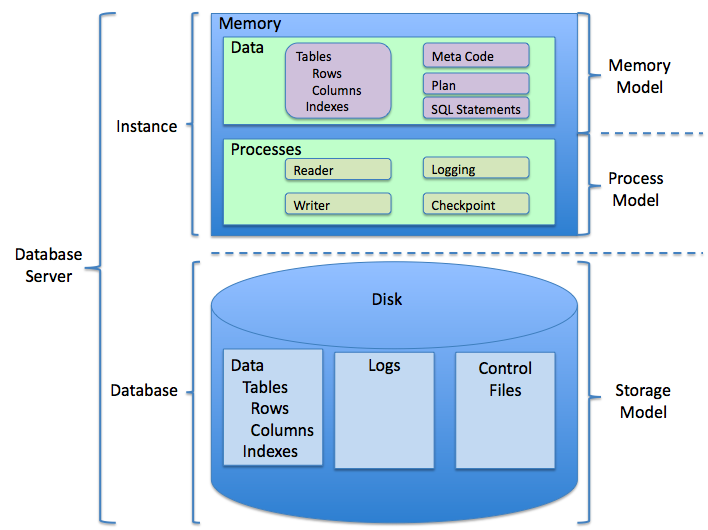 Enterprise RDBMS Architecture: Server Instance Memory Model, Process Model, and Disk Storage Model
An enterprise RDBMS provides client-server query processing, cost-based query optimization (CBO), memory buffer caching, lock management, automated backup routines, and cryptographic data-at-rest encryption.
Distributed relational databases
Distributed Relational Database Architecture (DRDA) and distributed consensus protocols enable networked database nodes to execute distributed transactions. Modern distributed SQL systems (NewSQL) implement two-phase commit (2PC) and Raft/Paxos consensus algorithms to deliver horizontal scaling across cloud data centers while preserving ACID guarantees.
Database engine list
Prominent enterprise and open-source relational database management systems include:
- Oracle Database: Industry-leading enterprise transaction engine known for Real Application Clusters (RAC), multi-tenant containers, and mission-critical financial processing.
- MySQL: The world's most widely deployed open-source web RDBMS, powered by the transactional InnoDB storage engine.
- Microsoft SQL Server: Comprehensive enterprise relational platform for Windows and Linux, featuring Transact-SQL (T-SQL) and integrated business intelligence tooling.
- PostgreSQL: Advanced open-source object-relational database renowned for strict SQL standards compliance, extensible types, JSONB indexing, and geospatial extensions (PostGIS).
- Snowflake: Cloud-native relational analytical data warehouse separating compute and storage for large-scale enterprise analytics.
- IBM Db2: High-performance enterprise relational engine optimized for mainframe and distributed multi-cloud transactions.
- SQLite: Self-contained, serverless, zero-configuration SQL database engine embedded in billions of mobile devices and desktop applications.
- Microsoft Access: Desktop relational file-based database engine used for rapid departmental reporting and prototyping.
- MariaDB: Community-driven open-source fork of MySQL created by MySQL's original founders, featuring specialized columnar and distributed engines.
For architectures connecting relational databases to distributed API layers, see Article 045, and for content management database designs, explore Article 058.


