
Application programming interface (API): principles and software integration

Application programming interface (API): principles and software integration
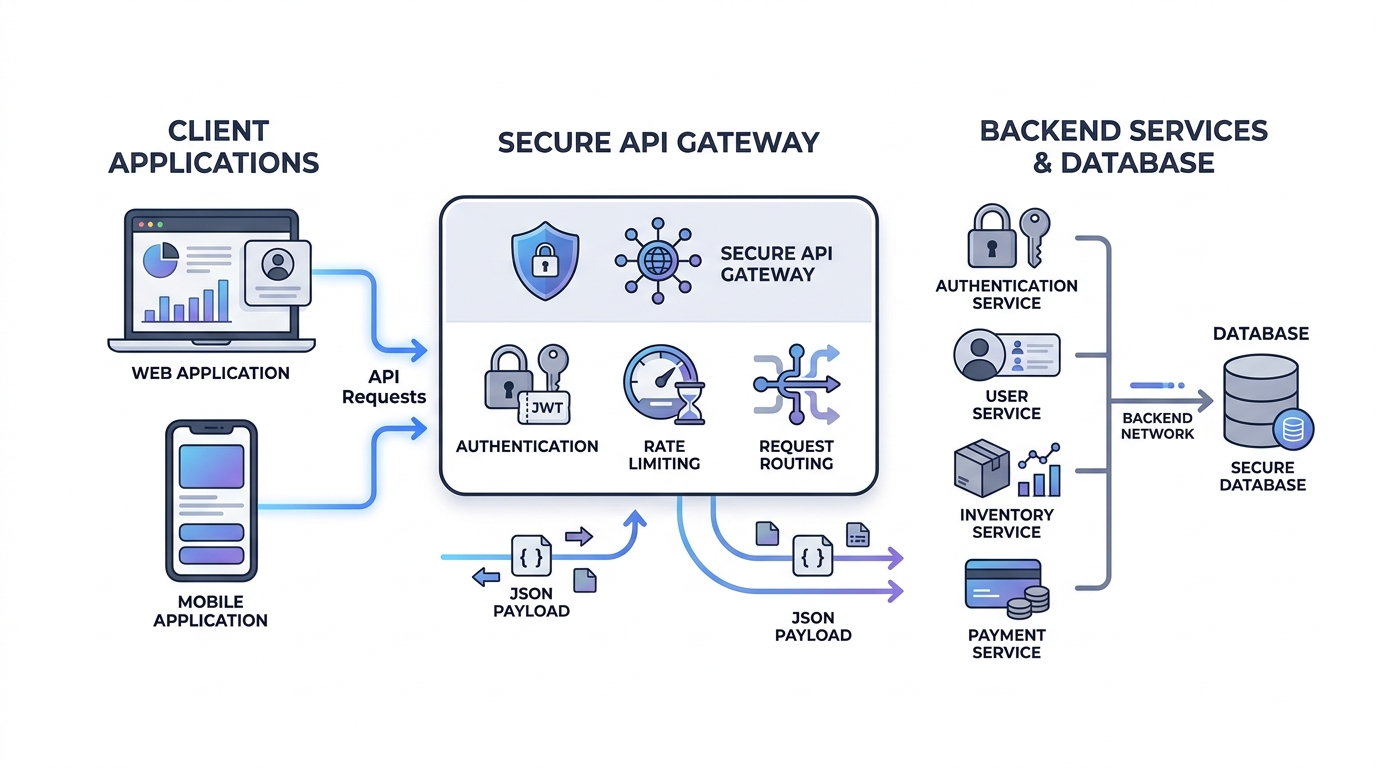 API Architecture & Software Integration: Client to API Gateway and Backend Services
An Application Programming Interface (API) is a standardized set of definitions, functions, and protocols that serves as a facade through which software components communicate and exchange services with one another. Offered by software libraries, operating systems, or cloud services, APIs provide a structured contract specifying how consumer programs interact with provider systems without requiring knowledge of internal implementation details.
We speak of an API whenever an IT system enables external programs to interact with its capabilities in a controlled, predictable manner while adhering to access constraints and security policies. In this paradigm, the provider system is said to "expose an API."
As such, interactions as diverse as the signature of a library function, a web endpoint URL, or systems integration and communication protocols are each considered programming interfaces within their respective domains.
In modern software development, applications rarely run as self-contained monoliths; they assemble functionalities provided by existing third-party platforms. This modular architecture allows engineering teams to build complex applications rapidly without reinventing foundational components. Software categories including operating systems, relational database systems, language runtimes, and cloud computing infrastructure all rely on programming interfaces to deliver their core capabilities.
Description
A programming interface is a clearly demarcated boundary through which software offers services to other software. The primary objective is abstraction: providing access to complex features while encapsulating implementation details. Depending on the environment, an API definition may include classes, methods, functions, data structures, and constants. Most commonly, local programming interfaces are packaged as software libraries that abstract low-level algorithms or system calls.
The API contract specifies the exact inputs, outputs, errors, and behavioral guarantees clients can expect. This contract allows an API to serve as a reusable building block across multiple independent applications. Software teams design APIs not only for third-party developers and industry ecosystems, but also internally to decouple microservices and internal system boundaries.
Usage
The creation and consumption of programming interfaces are fundamental to modern software engineering. A single application typically orchestrates dozens of APIs, ranging from operating system primitives to third-party cloud microservices.
In a service-oriented architecture (SOA), distributed applications communicate across networks using programming interfaces exposed as web services and RESTful endpoints using standard data exchange protocols.
Programming interfaces drive engineering velocity by encouraging specialization and component reuse. The advent of standardized languages like SQL and commercial relational database management systems (RDBMS) in the late 1970s illustrates this shift: instead of building proprietary storage engines, engineering teams consume battle-tested database APIs and focus their energy on core business logic.
Similarly, system-level APIs expose low-level operating system services safely. Standard network socket interfaces, for example, enable applications to establish TCP/IP communication without managing hardware device drivers directly.
Another classic example is the Windows API (Win32), which provides C-callable functions, data types, and constants enabling developers to manage processes, file systems, network communication, and graphical user interfaces across the Microsoft Windows ecosystem.
Market
In the contemporary software industry, applications rely on third-party platforms, operating systems, and managed cloud runtimes, each offering distinct APIs. From a commercial standpoint, an API is a formal contract in which a service provider specifies the capabilities offered, service level agreements (SLAs), rate limits, and pricing models.
Software assembly through APIs enables developers to integrate specialized capabilities—such as payment gateways, geocoding, authentication, and business process automation—without incurring the cost of building them from scratch. Developers only need to understand the interface contract: required parameters, return types, status codes, and error semantics.
Today, APIs are maintained, versioned, and distributed as standalone software products. Underlying implementations and infrastructure can be optimized or refactored continuously as long as the external API contract remains stable.
Common enterprise and developer APIs include:
- Azure API (including Azure API Apps and API Management)
- Facebook Graph API
- Google Maps API
- Salesforce API
- PicWish API
Examples of APIs
Examples by application domain
- 3D graphics: OpenGL, Vulkan (Khronos Group), Direct3D (Microsoft DirectX), and Mantle (AMD).
- XML document manipulation: SAX (Simple API for XML) and DOM (Document Object Model).
- Database connectivity: ODBC and JDBC for relational databases.
- Cartography and GIS: OpenStreetMap API and Google Maps Platform.
Functions of programming interfaces in Java
Programming interfaces fulfill diverse roles across an enterprise runtime. For example, in Java EE (now Jakarta EE), standardized APIs handle synchronous and asynchronous messaging, enterprise directory connections, database persistence, distributed transactions, mail dispatch, and XML serialization and registry operations (such as ebXML).
Higher-level APIs are often built to unify access to underlying libraries. The Java API for XML Processing (JAXP), for instance, provides a consistent abstraction layer allowing developers to plug in different SAX and DOM implementations (such as XML4J or Apache Xerces) without altering client application code.
Data transmitted
Programming interfaces routinely exchange metadata alongside business payloads:
- Enterprise software suites: Dedicated metadata APIs in Enterprise Resource Planning (ERP) and Customer Relationship Management (CRM) systems such as Oracle and SAP for introspecting relational schemas.
- Programming languages and runtimes: Reflection and data-access APIs that inspect schema definitions and data-source properties.
- Business intelligence and analytics: Metadata interfaces in platforms like SAS for querying data pipelines and model configurations.
- Relational database systems: Schemas and catalog APIs (such as IBM DB2 Cube) for OLAP dimensions and storage metrics.
- Enterprise content management: Bulk loading APIs that ingest documents along with access permissions and classification tags.
API management
API management is a comprehensive architectural practice and software discipline that enables organizations to publish, secure, govern, and analyze APIs across their lifecycle. Key capabilities include:
- Security and Gateway Protection: Enforcing authentication (OAuth 2.0, API keys), encryption, and data security controls to protect backend systems from unauthorized access.
- Traffic Control and Reliability: Applying rate limiting, throttling, and caching to ensure high availability and prevent traffic spikes from degrading service.
- Lifecycle Governance: Managing API versions, deprecation schedules, and backward compatibility.
- Developer Portals: Providing interactive documentation, SDKs, and developer onboarding workflows to streamline adoption.
- Analytics and Observability: Tracking latency, request volumes, error rates, and usage patterns to ensure compliance with service level objectives.
APIs as a product
In modern cloud computing, Web APIs are no longer merely technical integration layers—they are standalone commercial products that power entire SaaS business models. Pioneer companies such as Twilio, Stripe, and Algolia built multibillion-dollar valuations by delivering critical infrastructure (SMS, payments, search) through developer-first APIs.
Treating an API as a product requires prioritizing Developer Experience (DX) alongside core user experience (UX) principles:
- Intuitive Design: Consistent RESTful conventions, clear resource naming, and predictable JSON responses.
- Exemplary Documentation: Interactive API references, code snippets in multiple programming languages, and clear error catalogs.
- Instant Onboarding: Fast self-service registration, sandbox test environments, and transparent pricing.
- Reliability and Support: High availability guarantees, transparent status pages, and proactive developer support.
When organizations view APIs as strategic products rather than backend plumbing, they unlock new distribution channels, ecosystem partnerships, and sustainable recurring revenue streams.


