
Customer Relationship Management (CRM): Business Strategy and Software

Customer Relationship Management (CRM): Business Strategy and Software
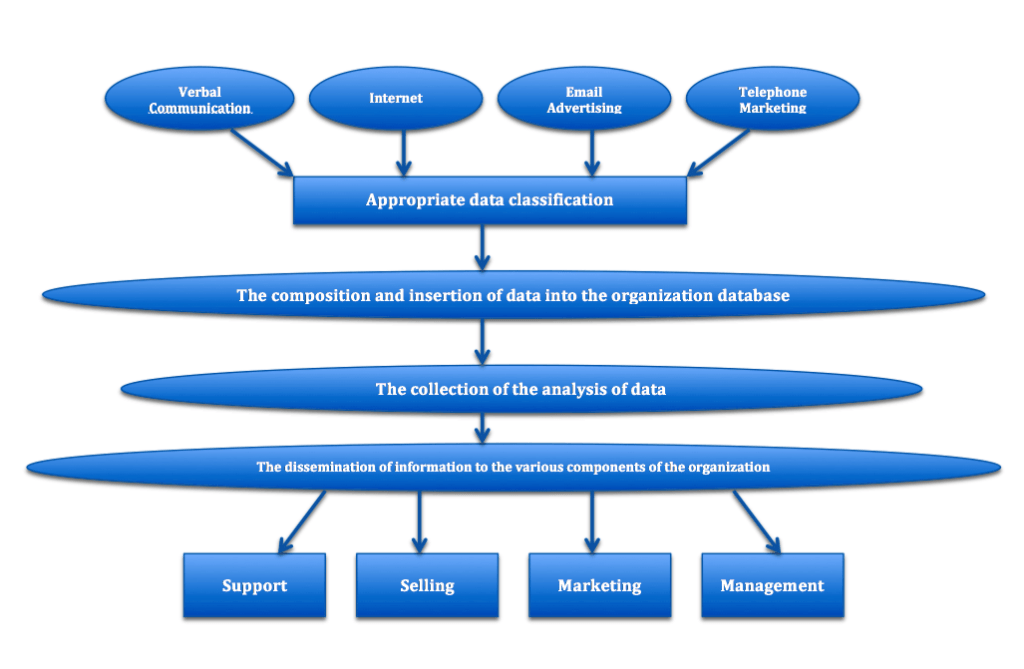 Customer Relationship Management Flow: Data Collection, Classification, Analysis, and Dissemination
Simple outline of customer relationship management showing multi-channel data collection, classification, database aggregation, analysis, and operational dissemination across support, sales, marketing, and management.
Learn how Customer Relationship Management (CRM) combines business strategy, organizational alignment, and enterprise software to optimize customer interactions, accelerate sales pipelines, and drive long-term retention.
What is Customer Relationship Management?
Customer Relationship Management (CRM) refers to the strategic practices, operational methodologies, and software technologies that organizations use to manage and analyze customer interactions throughout the entire customer lifecycle. The primary objective of CRM is to cultivate enduring business relationships, streamline sales and marketing processes, deliver responsive customer support, and maximize customer lifetime value (LTV).
The concept of CRM operates across two distinct but interconnected dimensions:
- Strategic Business Philosophy: A customer-centric organizational model where business decisions, product development, and operational workflows prioritize customer satisfaction, retention, and relationship equity over one-off transactional sales.
- Enterprise Software Application: Integrated database and workflow platforms—often connected with Enterprise Resource Planning (ERP), Product Lifecycle Management (PLM), and Supply Chain Management (SCM) systems—that record customer touchpoints, automate sales pipelines, and provide predictive commercial analytics.
By aggregating customer data across diverse communication channels—including corporate websites, email, telephone, live chat, social platforms, and customer portals—CRM software enables organizations to understand buyer intent, tailor commercial offerings, and eliminate friction during the purchasing journey.
According to enterprise market analyses from Grand View Research, the global CRM software market surpassed $65.59 billion in 2023 and is projected to expand at a compound annual growth rate (CAGR) of 13.9% through 2030. By enterprise market share, Salesforce leads the global cloud CRM ecosystem, followed by HubSpot, Microsoft Dynamics 365, and Oracle.
Core Functions of CRM Software
When customer records are fragmented across disparate spreadsheets and email threads, maintaining sales momentum and delivering consistent client experiences becomes nearly impossible. Modern CRM applications solve this fragmentation through core operational modules:
- Commercial Data Repository: Centralizes contact records, corporate hierarchies, purchasing histories, signed contracts, and real-time interaction logs into a single, unified customer profile.
- Audience Segmentation: Dynamically categorizes prospective leads and active accounts based on industry vertical, annual revenue, lifecycle stage, purchase frequency, and geographic territory.
- Sales Pipeline Management: Provides sales representatives and leadership with visual deal stages, pipeline velocity metrics, weighted revenue forecasts, and expected close dates.
- Sales Force Automation (SFA): Automatically assigns inbound leads to account executives, generates follow-up task reminders, and automates outbound email sequences, aligned with process automation best practices.
- Targeted Campaign Management: Coordinates multi-channel marketing campaigns, tracks promotional email open rates, measures digital lead generation costs, and assesses marketing return on investment (ROI).
- Customer Support & Service Desks: Manages post-sales service tickets, warranty claims, customer escalations, and onboarding checklists, linking seamlessly with internal request tracking systems.
CRM as an Integrated Enterprise Business Model
In their foundational work on customer-centricity, management theorists Don Peppers and Martha Rogers observed that:
"A customer-centric enterprise uses information to gain competitive advantage and achieve sustainable growth and profitability. In its most effective form, CRM is a set of practices designed to bring a company into closer, more profitable contact with each customer by learning about their specific needs."
To achieve this level of operational cohesion, modern CRM systems cannot function as isolated departmental silos. They must integrate tightly with enterprise backend operations:
- Engineer-to-Order (ETO) Workflows: Collaborating with engineering and manufacturing teams to ensure custom design specifications, client blueprints, and technical milestones align with sales agreements.
- Configure-to-Order (CTO) Pipelines: Connecting CRM product catalogs with live ERP inventory and dynamic pricing engines to generate accurate quotes for complex hardware or software configurations.
- Field Service & Lifecycle Support: Tracking post-sale maintenance visits, equipment warranties, and Service-Level Agreement (SLA) deadlines to proactively identify upsell and contract renewal opportunities.
As detailed in our architectural guide on CRM concepts and technologies, modern CRM platforms act as the vital bridge between frontend customer engagement and backend ERP logistics.
The Rise of Social CRM and Omnichannel Engagement
In traditional commercial models, transactional interactions were largely anonymous. With the emergence of global digital networks, however, single customer reviews, public testimonials, and community feedback can rapidly influence brand reputation across millions of prospective buyers.
Social CRM evolved to expand traditional CRM databases into dynamic conversational environments:
- Two-Way Conversational Dialogue: Rather than broadcasting unilateral marketing promotions, organizations use Social CRM to engage in real-time conversations across social networks (LinkedIn, X/Twitter), messaging apps (WhatsApp, WeChat), and community discussion forums.
- Real-Time Sentiment Monitoring: Natural language processing algorithms scan public brand mentions to detect customer dissatisfaction early, automatically escalating high-risk complaints to senior support managers.
- Omnichannel Identity Resolution: Linking a customer's social handle, mobile phone number, support ticket history, and billing records into an authoritative, 360-degree customer view.
- Community Advocacy & Feedback Loops: Rewarding engaged customers, gathering direct feature feedback, and leveraging user-generated content to guide ongoing product roadmaps.
Modern CRM Architecture: The Underlying Technology Stack
Modern enterprise CRM solutions rely on a sophisticated multi-tier technology architecture:
- Operational Data Layer: Relational databases and document stores that record transactional activities, user profiles, contact details, and audit logs.
- Business Intelligence & Analytics: Data warehouse pipelines that aggregate transactional metrics to generate revenue reports, churn projections, and executive dashboards.
- Artificial Intelligence & Predictive Modeling: Machine learning models that score inbound leads, predict customer churn risk, and suggest next-best-actions for account representatives.
- API Integration Layer: RESTful and GraphQL APIs that synchronize CRM records bidirectionally with accounting ledgers, payment gateways, marketing automation platforms, and external SaaS ecosystems.
FAQ
What is the difference between CRM and ERP?
CRM systems focus on frontend, revenue-generating activities—such as lead acquisition, sales pipelines, marketing campaigns, and customer support. ERP systems manage backend operational infrastructure—including general ledger accounting, inventory management, supply chain logistics, and human resources.
How does CRM improve customer retention?
CRM systems maintain exhaustive interaction histories and automated alert triggers. When an account exhibits declining product usage or submits frequent support tickets, the CRM flags the account for proactive customer success outreach before the client churns.
What metrics demonstrate successful CRM adoption?
Key indicators include shortened sales cycle times, improved lead-to-opportunity conversion rates, higher customer retention percentages, and improved customer satisfaction scores (CSAT / NPS).


