
Customer Relationship Management (CRM): Principles, Processes, and Organizational Implementation

Customer Relationship Management (CRM): Principles, Processes, and Organizational Implementation
Customer Relationship Management (CRM) combines strategic business principles with enterprise software architectures. For foundational technical design patterns, review our analyses of CRM technology and architecture and CRM business strategy.
Customer relationship management (CRM) is an approach to managing a company’s interactions with current and prospective customers. It analyzes the history of customer interactions with the company to improve business relationships, particularly customer retention, and support sales growth. An important part of this approach is CRM systems, which collect information from a range of channels, including the company’s website, telephone, email, live chat, marketing materials, social media, and others.
Through the customer relationship management approach and the systems used to facilitate it, companies are learning more about their target audiences and how to best respond to their needs; however, the adoption of a customer relationship management approach may sometimes lead to favoritism within the consumer audience, leading to dissatisfaction among customers and failure to achieve the overall purpose of the approach.3
Multiple systems
Operational CRM
The primary goal of CRM systems is to integrate and automate sales, marketing, and customer support. Therefore, these systems usually have a dashboard that gives a comprehensive view of the three systems on one page for each company's client. A dashboard typically provides customer information, purchases, past marketing efforts, and more, summarizing all relationships between the customer and the company. The operational CRM system consists of 3 key elements: sales force automation, marketing automation, and service automation.
A sales force automation system works with all stages of the sales cycle, from entering initial contract information to converting leads into actual customers. For example, in August 2000, Oracle released a customer relationship management software package, OracleSalesOnline.com, which creates contact lists, schedules and tracks performance online so that customer information is easily accessible to all workers whether in the office or remotely. systems Sales force automation analyzes sales promotions, automates the process of tracking customer account history, whether repeat or future customers, and coordinates sales, marketing, call centers, and retail outlets. In addition, it prevents the distraction of the efforts of sales representatives and customers and also monitors the paths of all communications and follow-up between the two parties automatically. The marketing automation system focuses on facilitating a comprehensive marketing process to make it more effective and efficient, for example, when the system monitors customer behaviour, the market power system through the marketing cloud provides business companies with the opportunity to form marketing campaigns that show customer interaction with the company.7 that the customer relationship management system tools with the automated marketing system can automate recurrent tasks, for example, sending e-mails and automated marketing messages in certain times for customers, or spreading social marketing information.
- Service automation is a part of a customer relationship management system that focuses on technology to serve customers directly. Through service automation, customers are supported through multiple channels such as phone, email, knowledge bases, ticket portals, FAQs, and more. For example, Microsoft's Dynamics CRM Software tracks the times of promotional visits, closing visits, and more in order to improve the efficiency of customer service within the business Commercial.
Analytical CRM
The role of analytical CRM systems is to analyze customer data collected through multiple sources and present it so that business managers can make more reliable decisions. Analytical CRM systems use techniques such as data mining, correlation, and pattern recognition to analyze customer data. These analytics help improve customer service by finding small problems that cannot be solved by marketing to different parts of the consumer audience differently. For example, by analyzing the purchasing behavior of its customer base, a company may find that its customers have not purchased many products recently. After scanning through this data, the company may consider remarketing its goods to this subset of consumers differently, by better communicating to this group how this company's products specifically benefit the group.
Collaborative CRM
The third basic objective of customer relationship management systems is to integrate external stakeholders such as suppliers, vendors and distributors, and to share client information across organizations, for example, feedback that can be collected from technical support team visits and can help guide the marketing of products and services for this client in the future.11
CRM Core Architectural Components
| Architectural Component | Core Capabilities | Primary Business Users | Strategic Metric Impact |
|---|---|---|---|
| Sales Force Automation (SFA) | Opportunity tracking, pipeline forecasting, quotation engine | Account Executives, Sales Managers | Shortened sales cycle duration; increased win rates |
| Customer Service Desk | Omnichannel ticketing, SLA tracking, knowledge base routing | Support Technicians, Service Leads | Lower First-Contact Resolution (FCR) latency; higher CSAT |
| Marketing Automation | Lead nurturing sequences, behavioral scoring, campaign analytics | Demand Gen, Growth Marketers | Higher Marketing Qualified Lead (MQL) conversion velocity |
| Customer Data Platform (CDP) | Real-time identity resolution, cross-channel profile unification | Data Engineers, Product Ops | Comprehensive 360-degree customer profile integrity |
Key components of customer relationship management include building and managing customer relationships through marketing, monitoring relationships that mature through distinct stages, and managing these relationships at each stage with the understanding that the distribution of relationship value to the company is not homogeneous. When building and managing customer relationships through marketing, companies may benefit from using a variety of tools to help design organizational structure, incentive plans, customer outlet structures, etc. to reach the highest return from their marketing campaigns. By being aware of the clear phases of CRM, companies are able to benefit from seeing the interaction of multiple relationships as connected businesses. When corporate management manages these relationships through their various stages, they gain important intelligence on, for example, which products have the highest probability of purchase. The final factor of customer relationship management highlights the importance of customer relationship management by accounting for the profitability resulting from customer relationships. By studying certain spending habits of customers, a company may be able to allocate different resources and interests to different types of consumers.
Relational intelligence
The company may be good in obtaining demographic data, such as sex, age, income, education, and linking it to procurement information to classify customers to profit levels, but this remains only a mechanical view of the company ' s relationship to customers.14 Thus, it is a sign that companies believe that customers are only resources that can be used as a function of humans, and when they are not used as transactors.
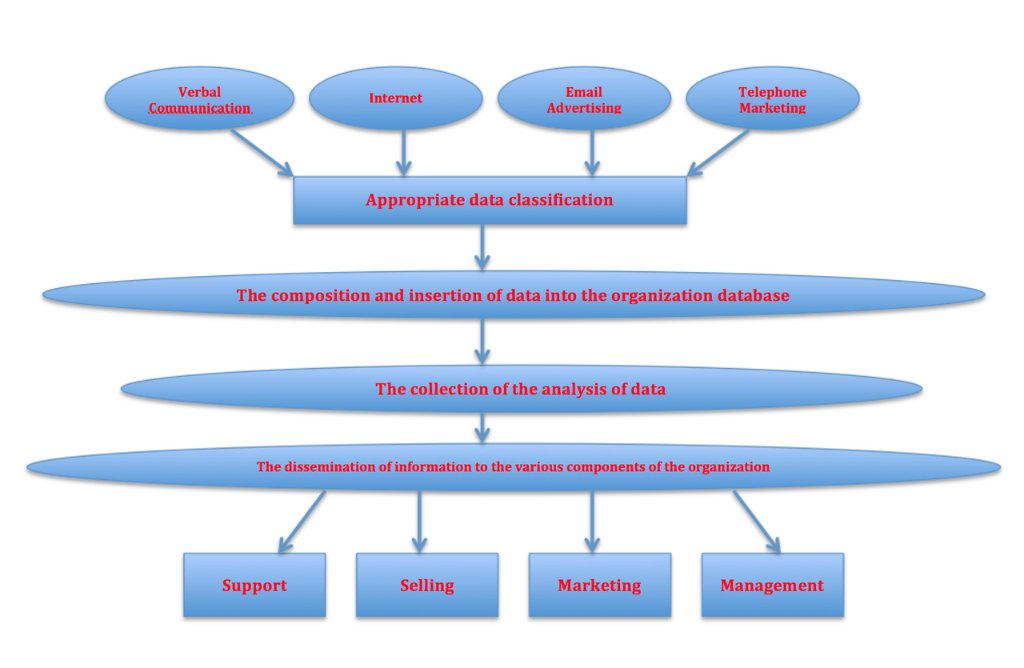 Customer Relationship Management Data Flow and Multi-Channel Processing Pipeline
Impact on customer satisfaction
Customer satisfaction has important implications for the economic performance of companies because it increases customer loyalty and usage behavior and reduces customer complaints and the possibility of customer defection. The adoption of customer relationship management is likely to have Impact on customer satisfaction and customer knowledge due to the following various reasons:
First, there are companies that are able to customize their offers to each customer. By collecting and processing customer interaction information, hidden patterns can be discovered, and customer relationship management applications help companies to customize their offers to suit the individual tastes of their customers. This customization enhances the perceived quality of products and services from the customer's perspective, and because perceived quality is a determinant of customer satisfaction, it follows that CRM applications indirectly affect customer satisfaction. CRM applications also enable companies to submit, accurately process customer orders and requests and continuously manage customer accounts in a timely manner. For example, Piccoli and Abalgat discuss how Wyndham has used IT tools to provide a consistent service experience across its multiple outlets to customers. Both improving the ability to personalize and reducing the variability of consumption experiences enhance perceived quality, which in turn positively impacts customer satisfaction. Furthermore, CRM applications also help companies manage customer relationships more effectively across the stages of relationship initiation, continuation, and termination. Service.
Examples
Research has suggested that a 5% increase in customer retention boosts lifetime customer profits by 50% on average across many industries, as well as an increase of up to 90% in specific industries such as Insurance. Companies that master customer relationship strategies have the most successful customer relationship management programs. For example, MBNA Europe had 75% annual growth since 1995 and the company invests heavily in pursuing potential cardholders. Once a new customer enters, the company seeks to keep him, as the company retains 97% of its profitable customers. They implement customer relationship management by marketing the right products to the right customers. The company's card usage reaches 52%, which is higher than the industry level, and the average spend is 30% more per transaction. Also 10% of their customers ask for more information about selling additional products.
Wells Fargo is another example of a company that has successfully implemented a CRM trend into their company. Wells Fargo's commercial banking division has approximately 300 different products and services, with many business clients using a range of products. Therefore, customers need a seamless experience from one product to another and from one service to another. The company implemented cloud technologies to help connect people with customers and saw customer satisfaction radically improve.
Amazon also experienced considerable success through its client orientation, where the company provided personal welcome, cooperative liquidations, etc. and also used customer relations management training to see up to 80% of customers as permanent agents.21.
The downside of CRM
One of the paradoxes in applying customer relationship management is the challenge of knowing what the system is and its goals. In addition, applying this approach may involve compliments and bias towards some customers, which results in some customers feeling unfair towards them and thus they may end their relationship with the organization and harm its reputation. This feeling of inequality causes dissatisfaction and mistrust. For example, Amazon experimented with using a dynamic pricing system (giving different prices to different customers) that ended in a poor customer relationship.
System development
Consultants, such as Payne and Kombani, recommend that it is important for companies to improve their outstanding intelligence when establishing customer relations systems.25 According to this argument, the company must recognize that people have many types of relationships with different trademarks. A research study on consumer relations in China, Germany, Spain and the United States, together with more than 200 trademarks in 11 industries, including airlines, automobiles and other media, has been considered very valuable because they provide negative information.
Information analysis
Based on this information, managers must understand the different causes of these types of relationships and provide customers ' searches. Companies can collect this information using questionnaires, interviews and others with current customers. For example, Freto Lee conducted several biographical interviews with customers in an effort to understand the relationships they want with companies and trademarks and found that most clients were adults who used the product to feel fun and to enjoy the colour of the company.26
Companies must also improve their outstanding intelligence for customer relations management systems. In these days, companies are stored and receive vast amounts of data through e-mails, online chat sessions, telephone calls, and more.27 All companies do not properly benefit from the use of this large quantity of data, and these signals indicate the types of relationships that customers want with the company, and the use of more important Internet access techniques.
Staff training
Many companies carry out training programmes to teach their staff how to identify clients and create effective relationships between their brands and their clients. For example, Harley Davidson sent their staff to their motorcycle lovers to help consolidate relationships, and other staff in social psychology and social sciences were trained to help strengthen strong relationships with clients. Client service representatives need to be educated to assess client relationships, and trained to understand the profiles of current clients.
Audit of operations and design of new operations
Companies whose operations are not well designed cannot be successful in achieving their objectives; companies should set their business objectives and evaluate, improve and expand customer relations management processes to suit their needs. New technologies are also useful, since the use of customer relations management systems requires changes in the Organization ' s infrastructure, as well as the deployment of new technologies such as labour policies, databases and information technology 26
Examples
Customer relationship systems
Data storage technology: used to compile information on the activities of the Organization, integrate information with customer relationship management products and provide key performance indicators.
Opportunity Management: It helps the company manage unpredictable growth and demand, and one of its tasks is to make a good sales forecast and later integrate it with sales history records. Client relations management systems that track and measure the impact of multi-net marketing campaigns and track client analysis through customers and sales. Some customer relationship management programmes are available as an online service accessible through the Internet, rather than on the local computer, and instead of buying periodic subscription fees to the programme provider.4. In small companies, the customer relationship management system consists of a system that manages communication and integrates client data such as e-mails, documents, employment opportunities, faxes and scheduling of individual accounts.31 Customer relations management systems are usually available in specific markets (legal and financial) that focus significantly on efficiency management and tracking the relationship with the reversal of financial return tracking systems on investment (ROI). Customer-centered relationship management (CCRM) is a new sub-trend that focuses on customer desires rather than doubling the number of customers. CCRM aims to add value by engaging customers in one-on-one and interactive relationships. Systems for non-profit organizations and member-based organizations to assist in the tracking of constituents and fund-raising processes, the distribution of herders, membership levels and evidence, volunteerism and communication with individuals.31
Customer relationship systems in use
Communications centres
In addition to tracking, recording and storing customer information, customer relations management systems at focal points organize interactions between the company and clients using key performance analyses and indicators to provide users with information on places that need to be concentrated in marketing and client servicing. The aim is to maximize income for each user, reduce the rate of client dislocation and reduce outreach efforts with reimbursable customers.32 customer relationship management software can also be used to identify and reward clients who have remained loyal to the Organization over a period of time.
Automated communications centres
Automated call center means the presence of an integrated system that coordinates communications between the organization and the public, and aims to reduce the repetitive and tedious routine work of call center employees and the center agent. Call center automation prevents this red tape by having pre-recorded voice messages that help customers solve their problems. For example, an automated call center may redirect customers to the specialized entity to serve the customer through a series of commands presented to the customer to identify the employee responsible for serving him. These programs can be integrated with the employee’s desktop computer so that he can deal with the customer’s questions and requests, which saves a lot of time. Employees.
Social media
Social CRM means using social media and technology to engage and learn from consumers. Because audiences, especially among young people, increasingly use social networking sites, companies use these sites to draw attention to their products, services and brands. Business, with the aim of building relationships with customers to increase demand. Some CRM systems integrate social media sites such as Twitter, LinkedIn and Facebook to follow and communicate with their customers. These customers also share their opinions and experiences with the company's products and services, giving these companies more information. Special customer feedback management software, such as Confirmit, Medallia, and Satmetrix, combines internal survey data with trends identified through social media, allowing companies to make better decisions. Accuracy about the products you supply.
On-site services
Customer relations management systems may also include techniques for the creation of geographical marketing campaigns, where systems in this case rely on client site information and sometimes incorporate GPS applications, which can be used for networking or networking, as well as to help increase sales based on location.8
Customer relations systems for business-oriented activities
Fair.|Fair source.
As defined by The Sweeney Group, CRM is “all the tools, techniques, and procedures for managing, improving, or facilitating sales, support, and related interactions with customers, prospects, and business partners throughout an organization.” This quote assumes that CRM is also involved in all business-to-business activities. (B2B). Although the general idea is that CRM systems were created for customer-focused companies, they can also be applied to B2B environments to simplify and improve customer management conditions. Customers.
Challenges of adopting CRM
Enterprise CRM deployments require strict data governance, robust identity management, and statutory privacy compliance, particularly under the General Data Protection Regulation (GDPR).
Companies face significant challenges in trying to implement customer relationships, and consumer-oriented companies often manage their relationships with their clients, 39 and often do not use their relationships with their clients effectively or adequately, because of misunderstood or misinterpreted client management, customers who want to be treated as friends may be treated as a mere reciprocal party.
Pioneers
The customer relationship management system market grows at 12.5 per cent in 2012.43 The following table summarizes the most important suppliers for 2006 - 2008 and 2012 - 2014 (in millions of dollars) according to a published study of Gartner.444546
| The supplier. | 2014 income | 2014 Percentage (%) | 2013 income | 2013 Percentage (%) | 2012 income | 2012 Percentage (%) | 2008 income | 2008 Percentage (%) | 2007 income | 2007 (%) | 2006 income | 2006 Percentage (%) |
|---|---|---|---|---|---|---|---|---|---|---|---|---|
| Siles Forres. | 4,250.4 | 18.4 | 3,292. | 16.1 | 2,525.6 | 14.0 | 965. | 10.6. | 676.5 | 8.3. | 451.7 | 6.9 |
| Sap-a-ji. | 2,795.1 | 12.1 | 2,622. | 12.8. | 2,327.1 | 12.9 | 2,055. | 22.5. | 2,050.8 | 25.3 | 1,681.7 | 25.6 |
| Zoho Foundation | 950.4 | 8.4. | 850. | 6.5 | 725.6 | 5.2 | 325. | 3.1 | 200.5. | 8.3. | 150.7 | 5.9 |
| Oracle. | 2,102.1 | 9.1 | 2,097 | 10.2 | 2,015.2 | 11.1 | 1,475. | 16.1 | 1,319.8. | 16.3 | 1,016.8. | 15.5. |
| Dynamox365 other languages | 1,432.2 | 6.2 | 1,392. | 6.8 | 1,135.3 | 6.3 | 581 | 6.4 | 332.1 | 4.1 | 176.1 | 2.7 |
| Others | 12,520.2 | 54.2 | 11,076 | 54.1 | 10,086.8 | 55.7 | 3,620 | 39.6 | 3,289.1 | 40.6 | 2,881.6 | 43.8 |
| Total | 23,100. | 100. | 20,476. | 100. | 18,090 | 100. | 9,147 | 100. | 7,674 | 100. | 6,214. | 100. |
As we can see the study included the four major CRM vendors 'Salesforce'Microsoft, SAP, And Oracle, with SizeForce having a market share of 18.4%, Microsoft having a market share of 6.2%, while SAP having a market share of 12.1% and Oracle having a market share of 9.1% in 2015. There are also other system providers that are popular with SMEs. The nine different categories of CRM include Enterprise CRM Suite, Mid-Market Applications, Small Business Applications, Sales Force Automation, Incentive Management, Marketing Solutions, Business Intelligence, Quality Data Consulting There are different market leaders catering to every different professional field from healthcare to manufacturing.
Enterprise CRM suite
Microsoft's system ranks highest in depth of system functionality and routing, customer satisfaction, and cost of software and maintenance for 5 years because it uses integrated products to engage customers, especially through 365 desktop and PowerBI, two business analytics platforms. While Microsoft's CRM platforms are mainly used in the financial services, public sector and professional services industries, its enterprise applications competitors, NetSuite, Oracle, Salesforce and SAP, cover additional areas such as retail, software, wholesale/distribution, communications, high-tech, healthcare and government services.
SFA and Mid-Market CRM Solutions
Fair.|Fair source.
In terms of mid-market applications, small business applications, sales force automation Microsoft is seen as the best in terms of depth of use of system functionality and routing, customer satisfaction and cost of software and maintenance for 5 years for its Dynamics CRM platform. This platform integrates different elements, engaging customers at multiple points. Microsoft's competitors in small business and mid-markets such as Hubspot, Infusionsoft, Zoho, BPMonline, NetSuite, Oracle, and Salesforce cover additional needs for areas such as real estate, communications, retail, software, wholesale/distribution, high technology, healthcare, government, agents, marketing agencies, consulting, and education.
Incentive management
In incentive management, Xactly is rated top for depth of functionality and direction, customer satisfaction and cost-per-year 5 for software and maintenance in sales performance management products. Xactly is known for providing powerful incentive management products for companies of any size, and most recently with its Insights product Xactly released in August 2014, helps companies compare themselves with their competitors in order to overhaul their business plans. Xactly covers the software/high-tech fields of business services and life sciences, and also provides tooling products for a range of professional fields. Xactly's competitors in incentive management, Callidus, IBM (Varicent), NICE Systems and Synergy, cover additional incentive management needs in areas such as insurance/financial services, telecommunications, banking and travel.
Marketing solutions
Salesforce's Marketing Cloud is known for its complex architecture that allows its users to connect to multiple applications and data sources inside and outside of Salesforce through a single browser interface. In terms of depth of functionality and direction, customer satisfaction and cost for 5 years for software and maintenance, Salesforce ranks higher than its competitors in the Marketing Solutions category. Although Marketing Cloud is mostly used in financial services, manufacturing/retail and high-tech fields there are other areas such as media, environment, communications and pharmaceuticals that are served by companies such as Adobe, IBM and Marketing Cloud from Oracle and Teradata.
Business intelligence
For the business intelligence group, the income of the first centres is mostly due to the depth of their system functions through the consolidated data structure of their products providing options for client classification, targeted campaigns and content allocation. Although their products are usually used in financial services, medicines and retails, there are other areas such as health care, communications, consumer products, insurance, wholesale trade, government and professional services, which are covered by IBS 52l and ITAS.
Data quality
When looking at the data quality category for customer feed management systems products, Informatica leads other companies for the depth of its system functionality, customer satisfaction and overall company direction. Although Informatica caters to healthcare, financial services and manufacturing industries, its competitors, Experian, IBM, Pitney Bowes and SAS, provide specialized data quality CRM products for areas such as government, retail, telecommunications, utilities and insurance.
Consulting
As for consulting, Appirio comes ahead of its competitors due to its expansion into mobile application development in the year 2015. Although Appirio caters to the retail, technology and education industries, its industry competitors, Capgemini, Ernst & Wing, Hitachi Consulting and IBM Global Business Services, serve the areas of communications, financial services, government, manufacturing and healthcare.


