
Digital signature: asymmetric cryptography and probative value

Digital signature: asymmetric cryptography and probative value
The digital signature or electronic signature is a mechanism for authenticating the author of an electronic document and guaranteeing its non-repudiation, by analogy with the handwritten signature of a paper document.
It differs from the written signature in that it is not visual, but corresponds to a series of characters. It should not be confused with the handwritten electronic signature.
Functions of the signature
A digital signature mechanism must have the following properties:
-
It must allow the reader of a document to identify the person or organization which affixed their signature (identification property).
-
It must guarantee that the document has not been altered between the moment the author signed it and the moment the reader consults it (property of integrity ).
To do this, the following conditions must be met:
-
authentic: the identity of the signatory must be able to be found with certainty;
-
tamper-proof: the signature cannot be forged. Someone cannot pass themselves off as someone else;
-
non-reusable: the signature is not reusable. It is part of the signed document and cannot be moved to another document;
-
unalterable: a signed document is unalterable. Once it is signed, it cannot be modified;
-
irrevocable: the person who signed cannot deny it.
In practice, most of the existing digital signature procedures are based on asymmetric cryptography, in the rest of the article we will place ourselves in this most common case. Examples of data exchanges are illustrated by the characters Alice and Bob.
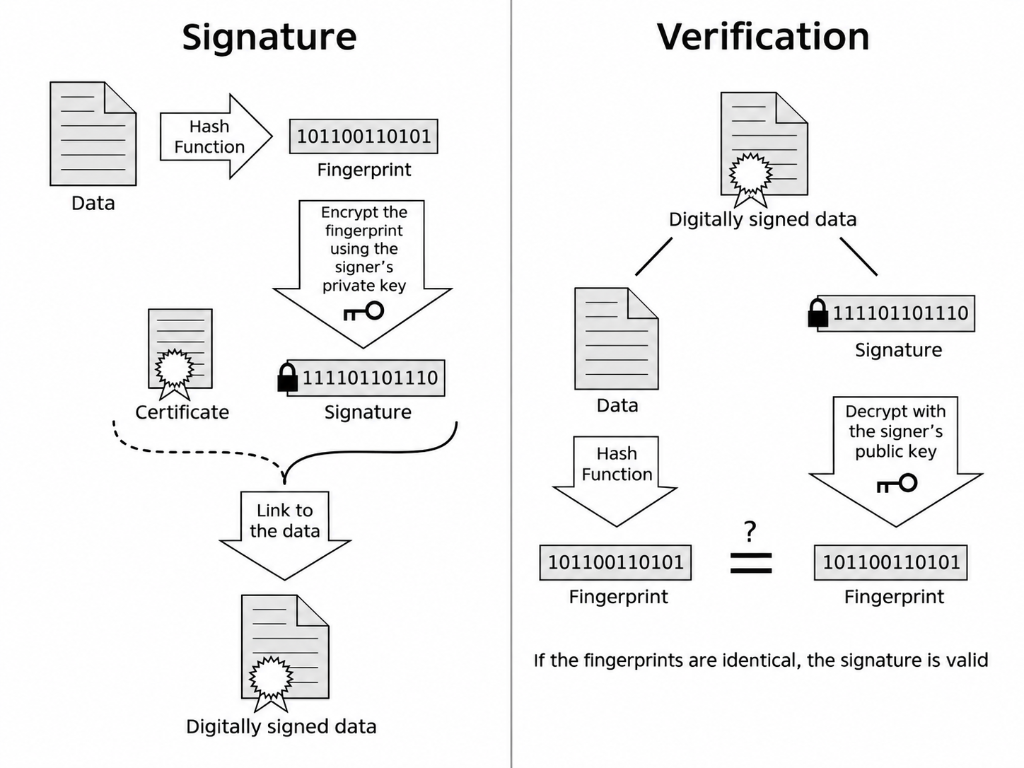 Digital Signature Cryptographic Hash and Verification Process
How RSA works
One of the signature algorithms is RSA. It is based on the asymmetry between the public key and the private key. For an asymmetric encryption algorithm, the public key is used to encrypt (anyone can send a confidential message) and the private key is used to decrypt (only the recipient can read it). Unlike DSA, there is no mathematical difference between the private key and the public key, it is possible to use the private key to encrypt and the public key to decrypt, therefore unlike asymmetric encryption. Thus, only the holder of the private key can encrypt a message to obtain what will act as a signature and everyone can try to decrypt the signature to see if the result obtained corresponds to the initial message. On the other hand, for greater convenience and to avoid rare bad mathematical cases, we prefer to encrypt not the original message but its fingerprint.
Implementing a signature architecture
-
Alice chooses a hash function which we will denote H;
-
for the chosen encryption, Alice generated a private key K_pr and a public key K_pb;
-
she transmits the public key K_pb and the hash function H to Bob via a possibly insecure channel (H and K_pb do not need to be secret);
-
she keeps the private key K_pr secret.
Alice prepares the signed message, for this:
Preparing the signed message
-
she produces a fingerprint of the message by the chosen hash function H(M);
-
she encrypts this fingerprint using the RSA C encryption function using her private key K_pr (note that this use is deliberately improper because normally we encrypt with the public key). The result obtained is the message signature: S_M = C(K_pr,H(M));
-
she prepares the signed message by placing the clear message M and the signature S_M in any container: M_signed=(S_M,M).
Alice transmits M_signed, the signed message, to Bob over an insecure channel.
Receiving the signed message
Bob receives the signed message. To verify the authenticity of the message:
-
he produces a hash of the plaintext using Alice's hash function: H(M);
-
he decrypts the signature using the RSA decryption function D with the public key K_pb (here again the use is deliberately improper) or: D_Sm = D(K_pb,S_M);
-
he compares D_Sm with H(M).
In the case where the signature is authentic, D_Sm and H(M) are equal because, by the properties of asymmetric encryption: D_Sm = D(K_pb,S_M)= D(K_pb,C(K_pr,H(M)))= H(M).
The message is then authenticated.
Protection against attacks
Suppose an adversary called Mallory wants to send a malicious message M' to Bob pretending to be Alice.
Mallory knows the elements D, H and K_pb which are not secret.
For Bob to be fooled and authenticate the message as coming from Alice, Mallory must be able to generate from these elements a falsified signature S_M' which is such that: D(K_pb,S_M')=H(M').
The task that Mallory must perform is therefore to reverse the decryption function D for the public key K_pb, that is, find C, without knowing the private key K_pr.
Asymmetric ciphers are precisely designed and chosen to make this operation mathematically difficult (if not impossible).
Vulnerabilities
From a theoretical point of view, the resistance of the encryption device will depend on the strength of the asymmetric encryption used and the size of the keys chosen. The standards implemented are generally considered mathematically secure.
From a practical point of view:
-
the digital signature remains subject to the problem of distribution/authentication of the public key. This problem is generally solved by the implementation of a public key infrastructure, leading to all the vulnerabilities inherent to this type of device;
-
the digital signature is a weak authentication because it relies solely on a memory factor, in this case the private key. If this is compromised, the attacker will be able to produce fraudulent messages that are theoretically completely indistinguishable from legitimate messages.
Variants
Historically, the first signatures were individual. Were subsequently introduced:
-
Group signatures where a member with their own key can sign for the group, the group leader (identified by their own key) being able to alone establish who issued the signature.
-
Ring signatures, which are similar to them, but where it is no longer possible to individually identify the signer.
Variants exist such as K among N, where the signature is considered valid if K members of the group among the N defined have signed. This system will be used for example when the authorization of several services is necessary to trigger a device with a severity exceeding the prerogatives of each of them. This would be the case, for example, for a telephone tapping procedure requiring the agreement of both an authorized body of the executive and an authorized body of the legislature. This prohibits the use of State information for personal purposes, since unblocking requires external coordination which will therefore itself be traced.
Legal validity
European Union
European legislation defines the conditions for technical and legal interoperability of digital signatures within the Union. The digital signature has been officially recognized in Europe since January 2000 (directive 1999/93/EC) but it is since July 1, 2016, the date of entry into force of the eIDAS regulation (electronic identification and security services). trust), that its minimum legal value is identical throughout the European Union (and some partner countries: Liechtenstein, Norway and Iceland). This regulation specifies in particular that the qualified electronic signature benefits from the same status and the same legal effects as its handwritten equivalent.
Three signature levels are recognized, simple, advanced and qualified,. The regulation in fact defines:
-
The electronic signature, which establishes a notional link between two sets of digital data: one constitutes a signature applying to the other. A simple electronic signature may therefore be limited to a name written at the bottom of an electronic message, does not necessarily guarantee the integrity of the signed data, etc.
-
The advanced electronic signature, which is an electronic signature for which technical links are established between signed data, signature and signatory aimed at guaranteeing the integrity of the data, the identification of the signatory, and non-repudiation. This level necessarily requires a digital signature, typically involving cryptographic means.
-
The qualified electronic signature, which is an advanced electronic signature based on a qualified certificate and created using a qualified signing device. This level adds quality assurance linked to the supervision of the means and processes implemented by the certification authority, and to the conformity of the qualified signing device hosting the certificate.
The eIDAS regulation similarly defines the notion of electronic seal, which can also be of an advanced or even qualified level. Technically identical to an electronic signature, an electronic seal differs in its certificate which identifies a legal person (typically an organization), not a natural person.
In the same context, the notion of electronic timestamp is also defined as being a set of electronic data which, associated with others, establishes proof of the existence of seconds at a particular moment. This electronic timestamp can be of qualified level.
In terms of legal interoperability, the eIDAS regulation establishes in particular the following elements:
-
A qualified electronic signature has the same legal value as a handwritten signature in all member countries.
-
A signature, stamp or timestamp submitted as proof in court cannot be refused solely on the grounds that they are in electronic form, nor on the sole grounds that they are not of a qualified level.
So that everyone can check whether an electronic signature, an electronic seal or an electronic timestamp is qualified, each member country must make available a list of trusted authorities (certification authorities, time certification authorities) which mentions at least all the qualified authorities. The inclusion of unqualified trust authorities is optional. The European Commission publishes a list of these national trust lists as well as a tool to visualize, browse and probe their contents.
In addition to legal interoperability, the eIDAS regulation and its implementing decisions also define elements of technical interoperability such as advanced electronic signature formats that public services must recognize. These formats are based on the ETSI technical standards.
Since July 1, 2013, it is the electronic version of the Official Journal of the European Union which has legal value. This electronic edition is published in the form of a collection of documents in PDF format corresponding to all the language versions of the same number, to which is added a document XML ensuring the integrity of the whole. This XML document, which contains a hash of each PDF document member of said collection, is signed by an authorized person of the Publications Office of the European Union by means of a time-stamped qualified electronic signature, according to the technical format XAdES.
France
The electronic signature of a document has the same legal value in France as a handwritten signature, in accordance with the following texts:
-
Law No. 2000-230 of March 13, 2000 adapting the law of evidence to information technologies and relating to electronic signatures;
-
Its implementation decree No. 2001-272 of March 30, 2001.
According to this decree, a secure electronic signature creation device must be certified as complying with the requirements defined above:
-
Either by the French Prime Minister, under the conditions provided for by decree no. 2002-535 of April 18, 2002 relating to the evaluation and certification of the security offered by information technology products and systems. The issuance of the certificate of conformity is made public.
-
Or by an organization designated for this purpose by a Member State of the European Union.
However, the complete transposition of European Directive 1999/93/EC required a longer process.
Since 2010, the concept of digital signature, defined as the conservation in digital form of a handwritten signature produced via a touch screen, has been introduced into French law by article R 249-11 of the code of criminal procedure.
The general security framework defines the rules that administrations and communities must respect in terms of information systems security. In particular, the annexes to the RGS specify the format of electronic certificates that administrations must use to implement electronic signatures within teleservices. Certificate management infrastructures that comply with the standard are certified using a method called “qualification”. These certificate management infrastructures are called Certification Authorities. Trusted third party, they guarantee the electronic identity of the company and its employees.
The Council of State has clarified that a decree published in the Official Journal, cannot be considered irregular, because lacks a handwritten signature, decision n°434004 of 12/30/2021 (External legality, paragraph 5).
Belgium
The Belgian legislature transposed the European directive of December 13, 1999 on a community framework for electronic signatures. This transposition into Belgian law was carried out by the adoption of two laws: the Law of October 20, 2000 introducing the use of means of telecommunications and electronic signature in judicial and extrajudicial proceedings which notably modifies article 1322 of the Civil Code and the Law of July 9 2001 establishing certain rules relating to the legal framework for electronic signatures and certification services. It is this last law which explains the question of certification services (PSC), their roles and responsibilities.
The electronic signature is now part of Belgian law and has the same legal value as the handwritten signature. Although much ink has been spilled on the doctrinal side, we can consider that it is today the subject of clear and rational regulation. The era of the Internet and electronics has arrived in the legal field and it was logical that the signature found its place there. The primary objective of European Directive 1999/93/EC of December 13, 1999 on a community framework for electronic signatures was to promote commercial exchanges across borders, to establish a certain confidence in these transactions and to confer on the whole a legal value equivalent to that of the handwritten signature.
Since February 2019, the ITSME application allows qualified electronic signature according to the European regulation eIDAS, it is available on the platforms of Connective, Doccle, Isabel Group and Luxtrust.
Switzerland
The digital signature (called electronic signature in legislative texts) has been recognized in Swiss law since 2003. It is therefore equivalent to the written signature required by law for certain forms of contract.
Little used in practice, the State Secretariat for the Economy (SECO) launched in May 2010 the “SuisseID” to promote and facilitate access to this technology for businesses and individuals. Intended to facilitate business transactions electronically, the system also allows, since 2011, the internet ordering of official documents (in particular the criminal record or an extract from the prosecution office) from public administrations, in accordance with the desire to implement place of an “e-administration” to facilitate access to such documents and reduce bureaucracy.
Quebec
The law concerning the legal framework for information technologies provides that “the signature of a person affixed to a technological document is enforceable against him when it is a document whose integrity is ensured and that at the time of signature and since, the link between the signature and the document is maintained”.


